Lumber Considerations
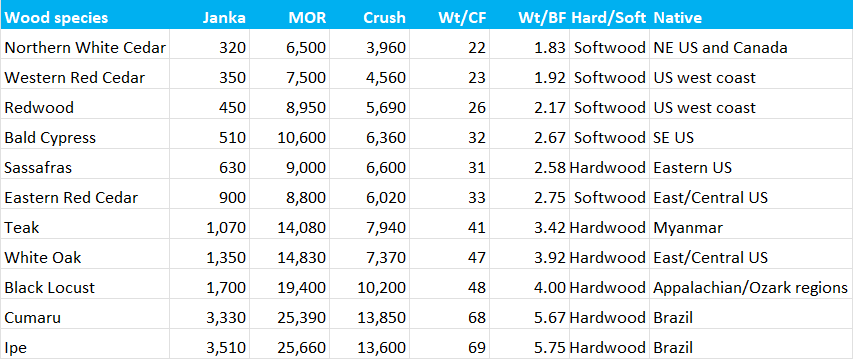
The first choice people have to make for their outdoor furniture is to decide on the material being used. Plastic furniture is readily available, comes in several colors and styles, and lasts for several years - or until it cracks due to some combination of weight, stress, or cold weather. Even newer products made with High-Density Polyethylene (HDPE) are susceptible to it., although HDPE is more durable than other plastics.
Wood is a great alternative to these petroleum-based plastics, as it has proven to stand the test of time in many weather conditions. Yes, we are a wee bit biased. When people make outdoor furniture, they want to use lumber that is resistant to insects and decay. They want their furniture to be enjoyed for many, many years.
Those same people agree that using pressure-treated lumber for outdoor furniture is a bad idea. Pressure-treated lumber is usually pine that has been soaked in chemicals to make it resistant to insects and decay. These chemicals include preservatives such as Alkaline Copper Quaternary or Copper Azone, and insecticides such as Dichloroctylisothiazolinone and Imidacloprid. You do not want people or food to come into contact with these chemicals.
If you are looking for better solutions, in 2021 the US Forestry Service prepared a 500+ page report on wood. The chart shows the wood species that this report states are very resistant or resistant to decay. We reduced that list even more to only show those species resistant to insects as well.
Let's talk about definitions. Some species are softwoods and some are hardwoods. Generally speaking, hardwoods are harder than softwoods. That is not always the case, however. For example, Balsa is a very soft wood that is a hardwood species. Hardwood species have their seeds encased. Cherry is a good example of a hardwood. Its seed is encased in a yummy fruit.
Sometimes we see a wood species that refers to its Janka hardness rating. This is a standard test that measures the ease with which a steel ball can be driven into the wood. The lower the Janka rating, the softer the wood.
As a point of reference, the aforementioned Balsa has a Janka rating of 67. You can often break it with just your hands.
Another aspect of these wood species is that a softwood does not mean the wood is actually soft. We know that very often decks and siding are made with cedar.
If the wood species is not susceptible to rot or insects, then what are potential issues? In general, wood tends to “move” due to changes in humidity. These movements include twisting, bending, cupping, shelling and checking. Although we minimize the first four, some users see seasonal checking or surface cracks. These cracks do not affect the strength of the rocker.
Due to previous excesses in harvesting, as well as a few fires, Redwood is currently on the International Union for the Conservation of Nature (IUCN) Red List of restricted species. As such, most woodworking companies do not use it.
Although close in the chart, Bald Cypress is a softwood while Sassafras is a hardwood. As you can see in the chart, they have Janka ratings harder than the cedars. Many large wooden boats had their frames built with Bald Cypress.
Another softwood is Eastern Red Cedar. Also named Aromatic Cedar, it is used to make cedar chests, cedar closets, fence posts and outdoor furniture. It is also misnamed, as it is actually in the Juniper family. Eastern Red Cedar is one of the hardest softwoods available.
When it comes to boatbuilding, many boat decks are made with Teak. The difficulty with Teak these days is its availability. The best Teak comes from Myanmar, which was once Burma. You will often find references to Burmese Teak. There is much unrest in that region and the Teak exports are used to exploit and control the population. As such, most woodworking companies avoid it, while others are fined thousands of dollars for using it. Recently, African Teak (Afromosia) has been used instead, but it is now on the IUCN restricted list due to overharvesting.
Many people do not think of White Oak as suitable for outdoor furniture. But it is! In addition to the aforementioned Bald Cypress, White Oak was also used extensively in the framing for large wooden boats. The demand has been high for it lately, however, as it is required in making barrels for bourbon.
Black Locust is not widely discussed because it is not widely found. Some people refer to it as the 100-year-wood, as many farmers used it for fence posts that are still standing 100 years later.
Finally, there are a couple of species native to Brazil. Ipe was the first species to get a lot of attention, as it is beautiful wood used to make decks. The popularity of the species is dwindling, however, as it has been extensively harvested. These days, many people looking for an alternative turn to Cumaru, although it is not mentioned in the Forestry Service report. Both contain oils that make them resistant to insects.
You may also see species differentiated by various measures of strength. Modulus of Rupture (MOR) measures the pressure in pounds of force per square inch that is required to break a piece of wood along the grain, while Crush strength has the same measurement but against the end grain. Weight/board foot just shows the weight of the species. Most woodworking companies rely on board feet to determine the final weight of the furniture.
Contact us
Interested in working together? Complete some info and we will be in touch shortly. We look forward to hearing from you!