Design considerations
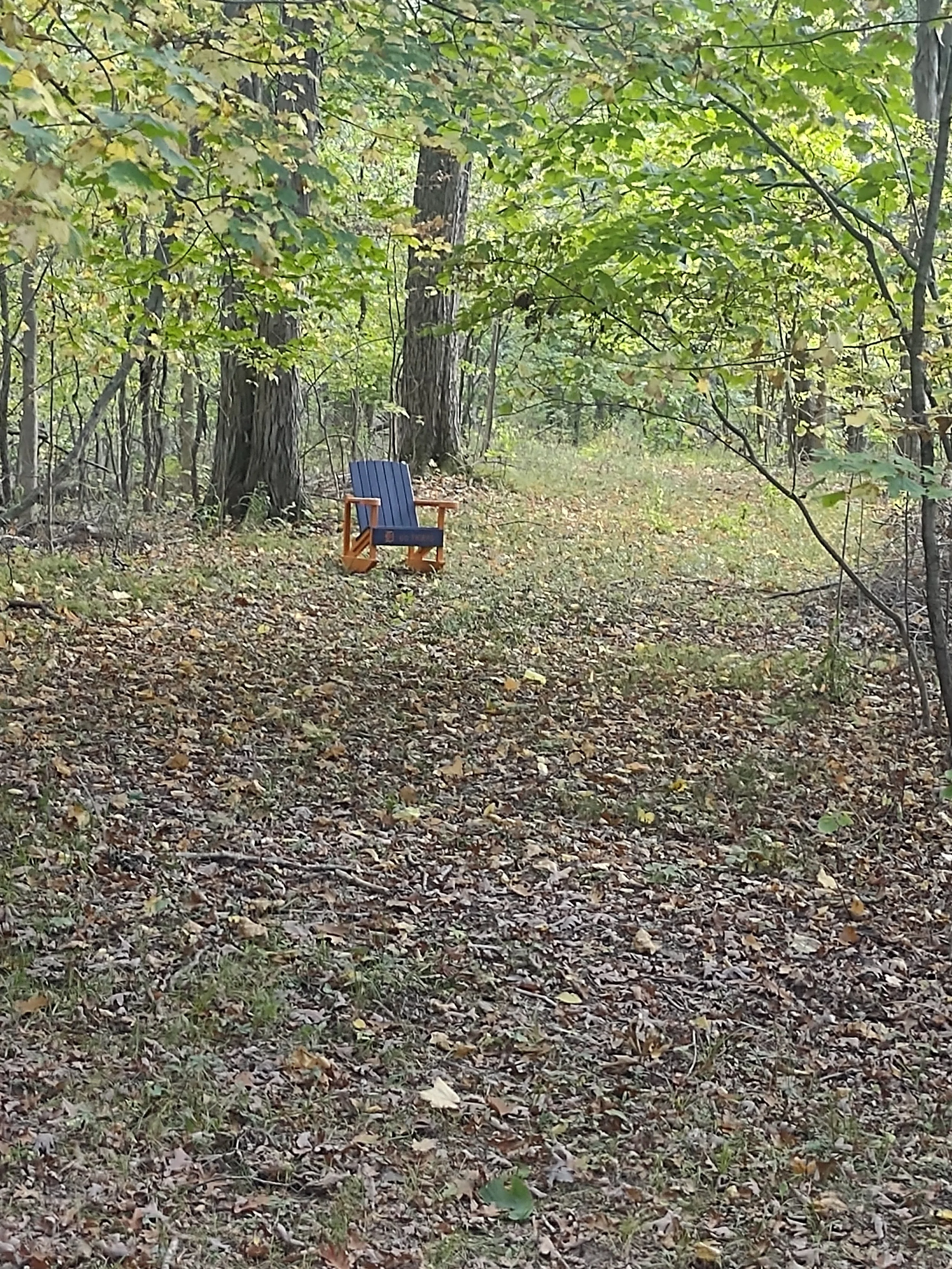
Here at Up North Rockers, we only make Adirondack rockers.  These are NOT YOUR GRANDMA'S ROCKERS.  If you are searching for a porch-style rocker, reach out and we will provide a recommendation.

Having worked at three of the top US-based furniture manufacturers, we understand the design principles involved in comfortable seating.  The goal is to provide support while reducing the stress on your spine.

Sitting makes your upper body weight compress your spine.  Research has shown that a way to relieve that stress is to sit with the seat back at an angle.  This research shows that the ideal angle is 135 degrees, while anything above 105 is helpful.  A completely upright (90) seat back is not comfortable, while a completely flat (180) seat back is really just a bed.  Halfway is that elusive 135.  How do we accomplish this?

The answer came in 1903 when Thomas Lee created the Westport chair, later renamed the Adirondack chair.  His goal was to create a chair that allowed his family to sit comfortably while seated on the downward slope of the hills near Westport, NY.  As it turns out, having the chair on a flat surface reclines the seat back.  His original design was improved upon by his friend Harry Bunnell and later by Irving Wolpin.  By making the seat sloped from front to back, the back is already at an angle that begins to support the spine.

An Adirondack-style rocker from Up North Rockers builds on that original design with three key features:

  • For our rocker, we start with an angle of 125 degrees for the seat back.  At this angle, you can sit around chatting comfortably with friends and family.

  • By rocking forward, the seat becomes almost level with the ground, so exiting the rocker is simplified versus the struggle some people have with Adirondack chairs.

  • Finally, the weight of the rocker has a lot to do with comfort - real or perceived.  A heavier rocker just feels solid.  The average weight of our rockers is 50lbs.

As our rockers are handcrafted to order, you should expect about eight business days between placing your order and having it ship. However, you should also expect your assembly time to be only eight minutes for the final five pieces. We provide the #2 Thompson square bit, but you will need a cordless drill or nut driver.

Enjoy a real wooden outdoor rocker made with Bald Cypress, which is known for its durability.

Quality Considerations

Quality comparison chart for wood Adirondack rocking chairs.

Joinery refers to interlocking pieces of wood to form a strong connection.  A common example seen in drawers are dovetail joints.  These joints are formed by shaping the two wood pieces such that they interlock.  By adding glue, the joint is even stronger.  Another common joint is the mortise and tenon.  In this case, the tenon fits into the mortise, doubling the glue area.  Most chairs made in the last 100 years use this type of joinery.

If the manufacturer does not use joinery, the alternative is really just carpentry.  At the low end of available products, nails or braids (staples) are used to hold wood pieces together.  Most manufacturers, however, provide screws in their kits for the user to assemble the final product.  A kit normally includes 30-60 pieces of wood plus an ample supply of screws.  Those products rely on the strength of the screws themselves to hold and to not break.  Because these manufacturers sell kits for the consumer to assemble, the manufacturers cannot take the extra steps to first glue and clamp the wood together.  By first using a waterproof wood glue and then adding screws, these extra steps provide a greater bond for the furniture.

A plug is a piece of wood that follows the screw into the hole and hides the screw.  The overwhelming majority of manufacturers do not use plugs.  That's because those manufacturers sell kits to be assembled by consumers.  They leave the screws exposed, which may result in water seeping in, rust forming, or even scratches to one's skin or decks from the hardware.  Of course, there are additional steps needed to offer products using plugs.  First, the screw hole must be predrilled and countersunk, leaving a gap between the screw head and the wood surface.  Once the screw is in place, a piece of wood is made to fit in the gap.  This flat head plug is glued into the gap.  Once the glue is dry, the excess wood from the plug is removed and the wood surface is sanded.

Wood thickness and species should be discussed together.  As an example, suppose you had to walk across a board to get from the rooftop of one two-story building to another.  Would you prefer to use a pine board or an oak board?  If you are like most people, your initial reaction is to say the oak board.  Most of us understand that oak is stronger than pine.  But what if the pine board was 1" thick while the oak board was only 1/2" thick?  We may need to call an architect friend to get some advice.  Of course, that advice may be to go downstairs and use the sidewalk.  Generally speaking, the harder the wood species, the thinner the boards can be without sacrificing safety.

No one wants to see rusty fasteners on outdoor furniture.  So, most manufacturers will use screws coated with zinc as a means to inhibit the rust.  Of course, if the zinc coating chips off the screw head during installation, rust will eventually appear.  The usual improvement over zinc coated screws is to use a grade of stainless steel known as 304.  The next step above that is grade 316 stainless steel.  Grade 316 has more molybeum content.  It is ideal for use near coastal areas where the air off the saltwater tends to be more caustic.

Last time we checked, people come in different sizes.  A critical mistake by many rocking chair manufacturers is that they create a one-size fits-all product.  Research has shown that rocker comfort is a function of the rocker leg height and rocker runner radius, both of which are derived from the height of the person sitting in the rocker.  As such, we have created four different sizes to ensure a comfortable experience.

We include two cupholders with our rockers.  From a market perspective, that may seem like a waste.  90% of the population is right-handed.  But we want our lefties to have a cupholder, too!  Our design even accommodates the two-fisted drinkers out there.  Finally, for those folks who need to stay connected, one cupholder can even hold a cell phone.  The Extra Large, Large and Medium rockers from Up North Rockers have two 316 stainless steel cupholders with drain holes.  They are 3.625" in diameter with a 2.6” section in the bottom, so a drink in a koozie should fit.  The Small rocker cupholders are 2.6" in diameter with no drain hole, making them big enough for a can of pop, bottle of beer, or a standard water bottle.  We use the smaller cupholders in order to scale down the rocker arms.

When we think of spacious seating on an airplane, first class seats come to mind.  Most first class seats are about 22" wide, which is the width between the seat legs of our Large rocker.  There are many chairs and rockers with contoured seats.  However, the University of California at Berkeley did research showing that too many contact points are actually detrimental to comfort.  We paid attention to the back-to-front shape and length in order to provide a supportive rocker that did not cut off one's circulation.  There are many mass production seats that simply extend upwards, thus hindering circulation just behind the knee.  There are other seats that provide a rounded area for the back of the knees, rather than having a flat apron.  Once again, circulation becomes an issue, especially if the seat length is too long.

Let's start by stating what may be obvious to some ... a cherry finish does not mean the wood is cherry.  Recently, we reviewed a website offering an Acacia rocker, which is a beautiful species from Africa.  Closer reading of the site, however, revealed that the wood used was actually actually Fir, which is not suitable for outdoor use.  So, caveat emptor - let the buyer beware!  Our Lumber Considerations section below describes the wood species that are generally accepted as being suitable for outdoor use.  The various finishes most often used on rockers include stain, polyurethane or paint.  There are very few manufacturers such as Up North Rockers, which offer products unfinished.  Unfinished allows consumers to finish the product and save some money, or to paint the product in whatever color they want.

Many people want to personalize their rockers.  However, the mass production rockers on the market do not accommodate this desire.  There are a limited number of manufacturers who provide this level of detail.  Some use laser engraving while others, including Up North Rockers, use a CNC machine to actually carve the wood.  Normal places to add personalization are either on the front of the rocker back or on the front board known as the apron.  These personal touches may include names, short messages or even logos.

Lumber Considerations

The first choice people have to make for their outdoor furniture is to decide on the material being used.  Plastic furniture is readily available, comes in several colors and styles, and lasts for several years - or until it cracks due to some combination of weight, stress, or cold weather.  Even newer products made with High-Density Polyethylene (HDPE) are susceptible to it., although HDPE is more durable than other plastics.

Wood is a great alternative to these petroleum-based plastics, as it has proven to stand the test of time in many weather conditions.  Yes, we are a wee bit biased.  When people make outdoor furniture, they want to use lumber that is resistant to insects and decay.  They want their furniture to be enjoyed for many, many years.

Those same people agree that using pressure-treated lumber for outdoor furniture is a bad idea.  Pressure-treated lumber is usually pine that has been soaked in chemicals to make it resistant to insects and decay.  These chemicals include preservatives such as Alkaline Copper Quaternary or Copper Azone, and insecticides such as Dichloroctylisothiazolinone and Imidacloprid.  You do not want people or food to come into contact with these chemicals.

If you are looking for better solutions, in 2021 the US Forestry Service prepared a 500+ page report on wood.  The chart shows the wood species that this report states are very resistant or resistant to decay. We reduced that list even more to only show those species resistant to insects as well.

Let's talk about definitions.  Some species are softwoods and some are hardwoods.  Generally speaking, hardwoods are harder than softwoods.  That is not always the case, however.  For example, Balsa is a very soft wood that is a hardwood species.  Hardwood species have their seeds encased.  Cherry is a good example of a hardwood.  Its seed is encased in a yummy fruit.

Sometimes we see a wood species that refers to its Janka hardness rating.  This is a standard test that measures the ease with which a steel ball can be driven into the wood.  The lower the Janka rating, the softer the wood.

As a point of reference, the aforementioned Balsa has a Janka rating of 67.  You can often break it with just your hands.

Another aspect of these wood species is that a softwood does not mean the wood is actually soft.  We know that very often decks and siding are made with cedar.

If the wood species is not susceptible to rot or insects, then what are potential issues? In general, wood tends to “move” due to changes in humidity. These movements include twisting, bending, cupping, shelling and checking. Although we minimize the first four, some users see seasonal checking or surface cracks. These cracks do not affect the strength of the rocker.

Due to previous excesses in harvesting, as well as a few fires, Redwood is currently on the International Union for the Conservation of Nature (IUCN) Red List of restricted species.  As such, most woodworking companies do not use it.

Although close in the chart, Bald Cypress is a softwood while Sassafras is a hardwood.  As you can see in the chart, they have Janka ratings harder than the cedars.  Many large wooden boats had their frames built with Bald Cypress.

Another softwood is Eastern Red Cedar.  Also named Aromatic Cedar, it is used to make cedar chests, cedar closets, fence posts and outdoor furniture.  It is also misnamed, as it is actually in the Juniper family.  Eastern Red Cedar is one of the hardest softwoods available.

When it comes to boatbuilding, many boat decks are made with Teak.  The difficulty with Teak these days is its availability.  The best Teak comes from Myanmar, which was once Burma.  You will often find references to Burmese Teak.  There is much unrest in that region and the Teak exports are used to exploit and control the population.  As such, most woodworking companies avoid it, while others are fined thousands of dollars for using it.  Recently, African Teak (Afromosia) has been used instead, but it is now on the IUCN restricted list due to overharvesting.

Many people do not think of White Oak as suitable for outdoor furniture.  But it is!  In addition to the aforementioned Bald Cypress, White Oak was also used extensively in the framing for large wooden boats.  The demand has been high for it lately, however, as it is required in making barrels for bourbon.

Black Locust is not widely discussed because it is not widely found.  Some people refer to it as the 100-year-wood, as many farmers used it for fence posts that are still standing 100 years later.

Finally, there are a couple of species native to Brazil.  Ipe was the first species to get a lot of attention, as it is beautiful wood used to make decks.  The popularity of the species is dwindling, however, as it has been extensively harvested.  These days, many people looking for an alternative turn to Cumaru, although it is not mentioned in the Forestry Service report.  Both contain oils that make them resistant to insects.

You may also see species differentiated by various measures of strength.  Modulus of Rupture (MOR) measures the pressure in pounds of force per square inch that is required to break a piece of wood along the grain, while Crush strength has the same measurement but against the end grain.  Weight/board foot just shows the weight of the species.  Most woodworking companies rely on board feet to determine the final weight of the furniture.

Comparison of best wood species for outdoor furniture including Adirondack rocking chairs.

Contact us

Interested in working together? Complete some info and we will be in touch shortly. We look forward to hearing from you!